


18 Months Leading Up…
They say that perfection is the enemy of good enough. If that is true, then maybe good enough is the enemy of perfection? In this post we will explore perfectionism, self-doubt, why striving for perfection can be bad and how instead being satisfied with ‘good enough’ can give rise to exceptional returns. I’m writing this post, the first on this site, after quite the personal journey. For the last two years I’ve dreamt of creating a blog. A blog where I can collect, condense and share the knowledge I gain along my journey to learn what I can about technology, artificial intelligence, philosophy and life. Welcome to The Learning Journey – and happy reading!
18 months ago I wrote my first post, pouring tens upon tens of hours into it. Most of that time was spent rewriting what I had written the day before. I was always searching for the “perfect” way to describe what overfitting is or the perfect metaphor to use in explaining what linear regression is and how it can be used. When it became hard to find ways to rewrite my text I instead started to doubt the very subject I wrote about. I constantly questioned whether this really was the “perfect” first post or the “absolute best” way to introduce someone to the field. You get the point – instead of progressing and getting work done I was running around in circles being afraid to explore what possibilities lay ahead.
Fast forward 18 months and all I had to show was a handful of half-finished drafts along with tons of references and sources on topics ranging from high performance computing to neural networks and search algorithms. All of it living in the murky depths of my computer, hidden away from the world. What had started as a passion project had instead ended up being a shameful collection of personal failures which I tried my best to hide from the world. Not quite what I had intended!
The Shattering of Illusions
I constantly tried to explain away my inability to get the blog started. My failure to publish was always blamed on lacking the time to polish to perfection, other commitments demanding my attention or that I simply didn’t know enough and needed to spend more time learning and researching. After a long hard look in the mirror, I realised what the real problem was. I was filling my time with other things so as to be able to explain with perfect reason why the project was not progressing. I gave my energy to other commitments in order to keep myself from finishing each post. And I was judging each post and finding it lacking in both depth and clarity, therefore being “excused” to push forward posting it until a point in time when I knew more. The real problem was my strive for “perfection“. This strive was not a badge of honour for having high standards but rather was a flurry of procrastination and excuses – used to shield me from facing the risk that maybe, maybe my content just *wasn’t good enough*. Or even worse, that maybe *I* was not good enough. The Marriam-Webbster dictionary defines perfectionism as “a disposition to regard anything short of perfection as unacceptable” [source]. The Psychology Dictionary defines perfectionism as “the prospensity to require of other people or of oneself a greater degree of performance than is mandated by the scenario” [source]. Damn, pretty heavy stuff. Another dictionary, the Cambridge Dictionary, defines perfection itself as “the state of being complete and correct in every way” [source].
Let’s reflect on that last definition. The odds that anyone would produce something that is complete and correct in every way is – let’s be honest – pretty slim. Smart as he was, even Isaac Newton didn’t live up to that definition. And I don’t see how any human possibly ever could! So assuming that true perfection really is unattainable, it is no wonder that none of my previous posts passed the test of perfection. Maybe the error and fault did not lie with what I wrote. Maybe the error lay in the metric with which I evaluated what I produced. And the standards I tried to hold myself to.
The Art of Reaching The End
A great businessman once said that if it were up to the engineers no product would ever be released. The engineer seeks perfection in the work and mastery of the field. The realm of possible improvements can sometimes be impossibly large. With no worries about the product reaching market in time or the revenue carrying the expenses, the engineer is free to revel endlessly in the art of perfection ad nauseam. That is why every engineering role needs to be complemented by someone who takes the bird’s eye view and who sees the larger picture. Someone who can see where the focus and energy needs to be directed, not only regarding the minute details of the product but in the larger context of the project.
The research chief at my summer job echoed a similar sentiment. We were developing algorithms for a novel approach to digital pathology, and I had spent almost three weeks perfecting aspects of the algorithm – after the groundwork for it was done and it was more or less functioning. At one meeting she finally said that I needed to stop fiddling around with my algorithm and get to the next stage (analysing the research data the algorithm was developed for). I said the algorithm wasn’t perfect yet and there still were many avenues of improvement and error-correction I wanted to try out. But her reply rang true to my ears the moment I heard them. “But what if we run the analysis and the algorithm already gives us good enough results? And also if the algorithm doesn’t produce a meaningful analysis – we will be better informed what parts of the algorithm needs improvement. She was right. I had gotten caught up in the beauty of perfection and art of engineering and lost track of the larger picture. The research project had a deadline and getting results was only one part of the job, the second was analysing the results and reporting the results. When doing research it is not uncommon that it is more important to have a result than it is to have the perfect result. Results can always be improved upon, either by your own research group or by fellow scholars in the field.
In other words, after a certain amount of work the product is more or less ready to go to the next stage of the project. It will not be perfect, there will for sure be flaws and aspects you might have missed. But the areas that matter where you missed and need to improve will often be noticed quickly. And you will find that other areas which you thought mattered and were important to fix – at the end turned out to not matter and any improvement on them would not only be redundant but a waste of precious time and effort. Some things are most clearly seen in retrospect. And sometimes the best way to figure out what to put your energy on next is to be brave enough to go ahead with what you already got and see how far it takes you. The wizard seeking meaningful impact can only stay in his ivory tower for so long before he needs to go outside and meet the real world.
Now, what constitutes “good enough” is definitely up for debate and the answer is not at all obvious! Famously people often say that 80% perfect is good enough. This can be true in many circumstances but as my mom rightly pointed out most people would probably feel quite uneasy with a brain surgeon satisfied at “80% perfect”. However even in critical situations such as surgery sometimes the worst thing one can do is inaction caused by indecisiveness.
T i m e I s L i m i t e d
Let’s imagine we have two sets. The first set, “Dreams & Aspirations”, is the set of all things you want to do and accomplish in your life. This is the set that contains all you dreams and aspirations, all the things you actually want to do. The second set, “Skills & Talents”, is the set of your abilities, opportunities and talents. You could think of it as the set of all your potential and all you actually could do. Drawing a Venn diagram of the two looks something like this:

To the left we have all the things we want to do. To the right we have all the things we could do. At the intersection of the two we have all the things you want to do that you actually also could do. But notice the intersection has an asterisk. That’s right, we actually have a critical set missing from this picture! If you would have infinite time on your hands and an eternal life, then spending eternity perfecting everything you do makes sense and is possible. But alas, given our current understanding of physics and biology and history – that you would have infinite time on your hands is somewhat rather improbable. We therefore introduce our final set, Time At Your Disposal, which is the set comprised of all the moments in your life – every second from now until you are out of seconds.
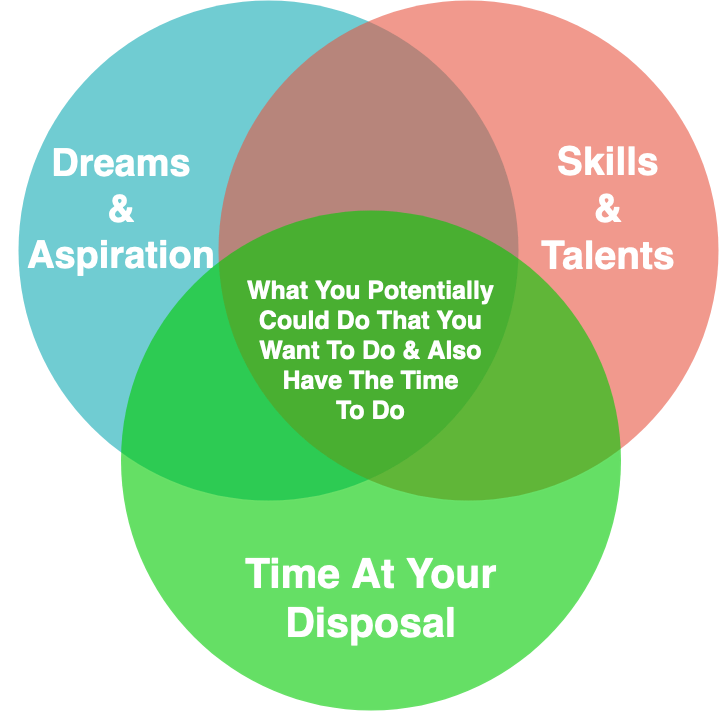
We now see that the set of what we actually can accomplish in this life is, in fact, much smaller than in the first model – where we did not have the time aspect. The set of dreams and the set of talents could theoretically be arbitrarily large. They both can be infinitely expanded on by finding new dreams or by training yourself and learning new skills. But time is different. It is bounded in size and we all only have a fixed amount of time in our life. What’s worse is – you don’t actually know how much time you have!
Indeed you do not only have to choose what you want to work with from what you could work with – but you also have to factor in how much time you want and should spend on each thing.
Using Good Enough To Your Advantage
– The Law Of Diminishing Returns –
Going from 50% perfect to 70% perfect is often easier than going from 70% perfect to 90% perfect. In fact, it is probably the case that it is even harder to go from 90% to 95% perfect, and even harder still to go from 95% to 99% perfect. The cost of improvement becomes ever higher the closer to perfection you strive. This is a often reoccurring idea in the fields of engineering and research and product development and is in fact so common that it has it’s own name: The Law of Diminishing Returns. The Law of Diminishing Returns can intuitively be understood by imagining that we are trying to learn a new skill – such as juggling or working out to build muscles. In the beginning you see extreme progress fast, but as you get better or stronger the pace of improvement starts to slow down. While in the first months you set new records every week, after a couple of years the pace of improvement might have slowed down considerably – only reaching new milestones every once in a while.
Engineer at heart as I am, I’m thinking that at some point the scales tip and you start wasting your time more than you improve whatever it is you are doing. In other words – at some point whatever you are doing is simply good enough and your time and focus is better spent elsewhere.
That last point is in fact so important that I will repeat it once more. At some point your time and focus is better spent elsewhere.
Let’s take an everyday situation and draw it to the extreme to illustrate this point. Imagine that you have misplaced your phone at home and need to find it. You have five rooms to look in, and in each room there are several places to look. Now, given no other objectives in life and an infinite amount of time you for sure could search each inch of every corner perfectly and in the absolutely highest degree of precision. But, most of us have several things going on in life, and the time available to us is finite and not infinite. At some point you need to accept that the phone isn’t in the first room and you need to proceed to search for it in the next room. You might not find it in any the four other rooms and conclude that you didn’t search carefully enough in the first room. So you go back and search more thoroughly. But at some it is simply not worth it to place more time and energy on searching for your phone in the first room, or in the house at all. It might turn out that you forgot them at work and your whole premise was wrong from the start. At some point you might need to look elsewhere. But for how long? How many hours, days, months or years would you spend on finding your phone before simply accepting your loss and buying a new phone?
Let’s wrap up by comparing two scenarios, and in the process explore how the Law of Diminishing Returns might help us to accomplish more with our time. Let’s imagine we want to start blogging about stuff we learn, and at our disposal we have 18 months. We have two approaches, or strategies, that we can test. The first strategy is striving for absolute perfection in everything regarding the blog. Following this, anything short of true mastery for every post is completely unacceptable. Here we are 100% detail oriented and look only at every component in isolation. The second strategy is to ease the detail oriented focus and instead focus on the whole picture. This second strategy takes the law of diminishing returns into account and instead of perfecting every single post we try to maximise the blog as a whole and to improve our mastery across blogs over time.
The first strategy leads to us obsess over details that in the grand scheme of things might turn out to be completely inconsequential. Choosing a good font for the text in the blog is important, but there are many good ones and in the end the choice of one great font over another great font really doesn’t matter. Spending an hour on finding the best font is maybe time well spent, but spending a whole week is probably madness for a blog that doesn’t even have it’s first post published. Similarly choosing which example to use to illustrate linear regression is only worth investing so much time in. Maybe you won’t find the best example, and your time is better spent by choosing any direction that is good enough and work to make headway with that. Otherwise, the net result is that whatever post is produced risks being overworked and whatever work is completed is redone in order to find the perfect start. In fact, having the perfect start soon becomes more important than actually getting somewhere. And even worse striving for complete perfection can cripple us with fear over the insufficiency of whatever we produce, risking that we end up not daring to publish anything at all. Over the span of our 18 months little to no real result is obtained.
In the second strategy we instead focus on actually producing things. We are more obsessed with having X number of posts written and published in these 18 months than we are of the individual quality of each post. The first few post are pretty good but far from perfect and may not even be up to the standard we feel comfortable with and would like to have. But we ignore the voice in our head saying that it isn’t ready yet and we push on. And before we know it, we’ve actually gained some momentum in publishing and start building a habit of writing. What is produced might be less than perfect quality wise, it might even be mediocre. But thinking about it, it is kind of unreasonable that we would be able to produce anything extraordinarily good without any prior experience. And gaining experience is what this second gives us. By gaining experience we position ourselves better to produce higher quality content. And we additionally have something to show others and ourself. After 18 months it might still not be perfect but it is definitely improving, and in the end it might be better to start as an apprentice of something than being a master of nothing.
So, there you have it – my debut post. Is it all I imagined and dreamt that it could be and is it the absolute best first post I could ever have created? No, far from it. But this post is actually real and it is actually posted. It is something that I manifested into reality and it is good enough – and it is therefore infinitely better than any unmanifested dream of perfection.
 The Learning Journey